Vitamin B6 and dream recall: what the experiment showed
The most common complaint of beginners in lucid-dream practice: 'I don't remember what I dreamt.' Without memory no induction technique works — you cannot search for dream signs in entries that do not exist. So the first task of any protocol is to improve dream recall.
In 2018 an Australian team led by Denholm Aspy (University of Adelaide) published a small but methodologically clean study: 100 participants, double-blind and placebo-controlled. The active group took 240 mg of vitamin B6 (pyridoxine hydrochloride) before bed for five consecutive nights; controls received placebo. The morning after the cycle both groups logged their dreams. The result was narrow but important: B6 significantly improved the ability to recall dreams. It did not, however, affect the vividness, bizarreness or colour of dreams. Recall improved, not the richness of the scenes themselves.
Mechanism. B6 is a cofactor in the synthesis of serotonin and other neurotransmitters that regulate sleep architecture. The precise path by which it boosts recall is not fully understood, but the working hypothesis involves modulation of hippocampal activity at the transition from REM to waking — the window in which a dream scene either crosses into declarative memory or is erased.
Dosage. 240 mg is roughly 14× the recommended daily allowance (~1.7 mg). Standard pharmacy packaging contains 5–10 mg tablets. So anyone wishing to replicate the experiment should note: long-term high-dose B6 (>200 mg/day over months) is associated with peripheral neuropathy. The safe corridor is 4–7-day cycles with breaks.
My recommendation. If you're just starting and remember nothing in the morning, begin with the basics: a notebook by the bed, recording immediately on waking, without opening your eyes. After 7–10 days recall improves by a factor of 3–5 on its own. If that is not enough, a short B6 cycle can add another step. But it is not a substitute for journal discipline.
What does not work. Caffeine and stimulants in the evening — degrade both REM quality and recall. Alcohol before bed — suppresses REM in the first half of the night and fragments sleep. Late food and heavy training within 2 hours of sleep — shorten REM. Basic sleep hygiene predicts recall more powerfully than any supplement.
FAQ
- Does vitamin B6 help you remember dreams?
- In Aspy's placebo-controlled study (2018, 100 people) 240 mg of B6 before bed significantly improved the ability to recall dreams. It did not affect vividness or colour — recall is what improves.
- What B6 dose for dream recall?
- The study used 240 mg before bed — about 14× the daily allowance. Long-term high doses (>200 mg/day for months) carry a risk of peripheral neuropathy, so short 4–7-day cycles with breaks, after talking to a doctor, are safer.
- What works better for recall — a supplement or a journal?
- The journal. Recording immediately on waking improves recall 3–5× in 7–10 days with no supplement at all. B6 is an optional add-on, not a replacement for discipline.
The CIA Astral Projection Report: What the Gateway Document Actually Says and What Was on the Missing Page 25
The document is real and you can download it: 29 pages, dated 9 June 1983, signed by Lieutenant Colonel Wayne McDonnell. It is not a CIA report and not a manual for astral projection — it is an Army memo assessing a commercial audio course. Here is the primary source: what it says about leaving the body, why one page was missing for eighteen years, and what turned out to be on it.
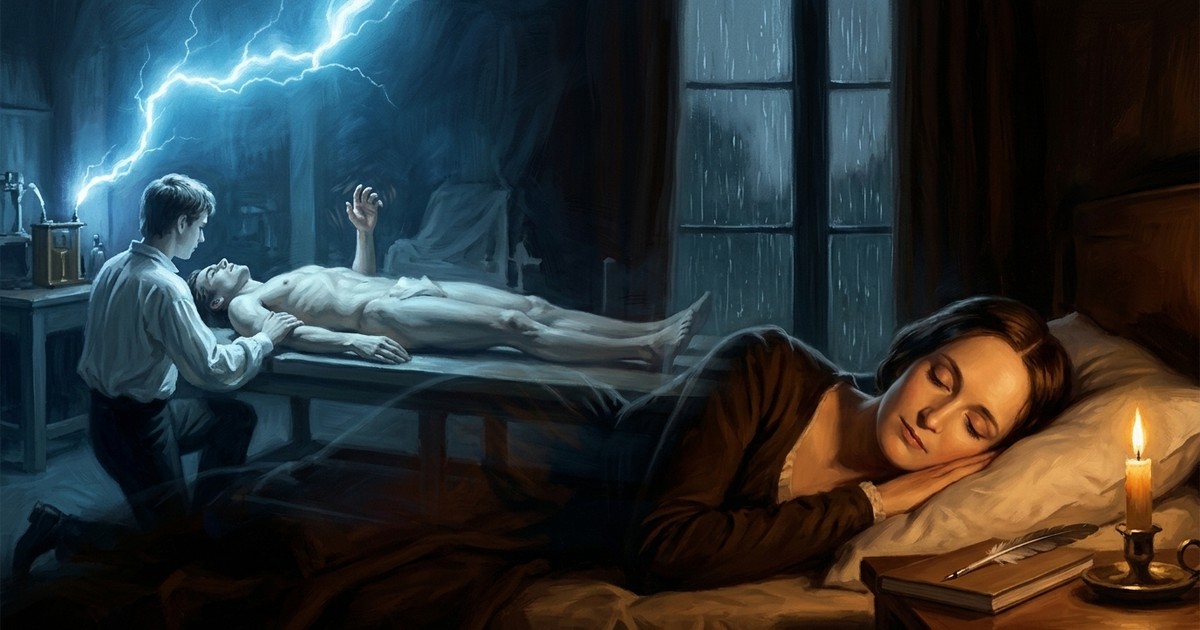
Mary Shelley Dreamed Frankenstein — Except She Wrote That She Was Not Asleep
Mary Shelley described that night herself: “I did not sleep, nor could I be said to think.” Not a dream but the threshold of sleep — and before it came days of deliberate work on an assigned problem, a late-night conversation about the principle of life, and years of a trained childhood habit of “waking dreams”. Here is the primary source, the 1831 introduction, together with where it is weak.