Back to blog

Carl Jung’s Active Imagination: How He Trained Himself to Enter His Own Images

By: Andrey Zaruev·Updated 28 July 2026·6 min read
Carl Jung’s Active Imagination: How He Trained Himself to Enter His Own Images

Carl Jung’s name is welded to dreams more firmly than anyone else’s. But the thing worth borrowing from him is not dream interpretation — plenty of people did that. It is the date. On 12 December 1913 he sat down at his desk, made a decision, and deliberately stepped inside his own images. What grew out of it was a practice he ran for years and wrote down as he went. Not a flash of insight. Training.

The date he decided

Jung records the step with the precision of a protocol. “It was during Advent of the year 1913 — December 12, to be exact — that I resolved upon the decisive step. I was sitting at my desk once more, thinking over my fears. Then I let myself drop,” he writes in Memories, Dreams, Reflections. What follows is the ground giving way underfoot and a plunge into dark depths. But the important part is not the imagery, it is the verb: he let himself drop. Knowingly, aware of the risk — and he came back to it for years, not for one evening.

What he actually did

The mechanics of what he later called active imagination are mundane. Explaining the method in a 1947 letter, Jung lays it out in steps: “You start with any image… Contemplate it and carefully observe how the picture begins to unfold or change.” Then you go inside it: “Eventually step into the picture yourself, and if it is a speaking figure at all then say what you have to say to that figure and listen to what he or she has to say.” And a third element he insisted on separately: “The alterations must be carefully noted down all the time.” The notes went first into his Black Book, and later into the illustrated Red Book. Nothing esoteric on the list: look, enter, speak, write.

Why it worked

Jung names the mechanism himself, and it is a down-to-earth one. “To the extent that I managed to translate the emotions into images… I was inwardly calmed,” he writes; left hidden in the emotions, those same images might, in his words, have “torn me to pieces.” An affect you cannot get hold of becomes observable the moment it acquires a form. Of his conversations with an inner figure he called Philemon, Jung writes: “He said things which I had not consciously thought… it was he who spoke, not I.” Some contents of the psyche have a life of their own — and you can stay conscious and watch while they do. That is exactly what you meet in a lucid dream: the scene runs itself, and you are present inside it.

1944: the part that happened against his will

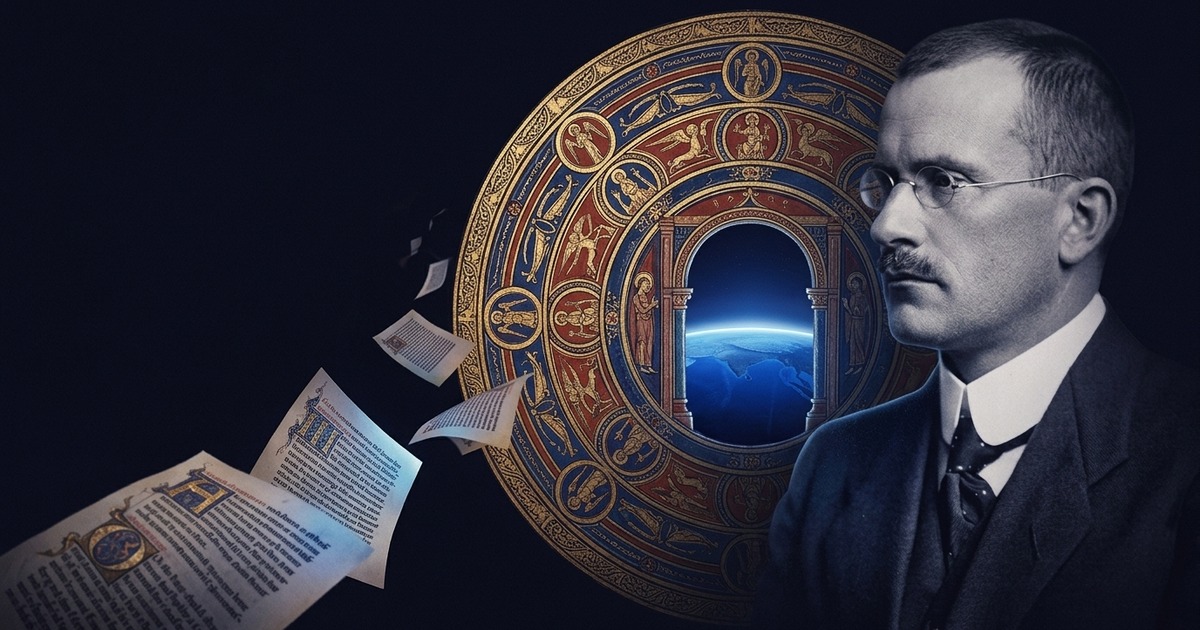
Now, honestly, about the most famous episode of his life. At the beginning of 1944 Jung broke his foot, a heart attack followed, and between life and death he went through what today would be called a near-death experience. “It seemed to me that I was high up in space. Far below I saw the globe of the earth, bathed in a gloriously blue light… Far below my feet lay Ceylon, and in the distance ahead of me the subcontinent of India,” he recorded, adding: “Later I discovered how high in space one would have to be to have so extensive a view — approximately a thousand miles!” He described the view of Earth from orbit seventeen years before the first human being actually saw it from there. But it was not a trained feat, and saying otherwise would be dishonest: it happened in a hospital bed, and Jung concedes, “I do not know whether I was in a dream or an ecstasy.” What he did insist on was its reality: “It was not a product of imagination… there was nothing subjective about them.”

The same door, opened on purpose

Separate those two things and the picture turns practical. The 1944 vision arrived without Jung’s participation — states like that are not worth hunting, and certainly not worth paying for with your health. What he did from 1913 onward can be trained today, and his own elements line up almost literally with the practice of lucid dreaming. The writing is a dream journal, and that is where to start. Jung’s “contemplate the image and step into it,” done as you fall asleep, is dream incubation and the direct route into the WILD technique. By day, add reality checks; before sleep, practise MILD so that awareness, not just imagery, follows you across the threshold. Once inside, a separate skill takes over — holding the state. And the most Jungian move of all, talking to a figure from a dream, is also used therapeutically: to rework nightmares and trauma.

How to walk this path with guidance

Jung walked this road alone and called the undertaking a dangerous enterprise — he had neither a map nor a teacher. You have both: the same elements are now arranged into a clear sequence you can work through calmly and gradually. If you want to walk it with guidance, explore my method and apply.