Lucid vs vivid vs nightmare dreams: the difference
In everyday speech, "vivid", "lucid", and "nightmare" are often used as synonyms — especially when talking about a memorable dream. This confuses not only beginners but also journalists and sometimes specialists. Meanwhile, these three categories are three distinct states with different neurophysiology, different working methods, and different consequences. Sorting them out is worthwhile before choosing a practice technique.
Tamara Stumbrys and Daniel Erlacher offered working definitions in their 2012 review, which the scientific community now uses. Lucid dream — a dream in which the dreamer knows they are dreaming and holds that knowledge throughout the scene. Control over content is an optional characteristic: you can be a lucid observer without active intervention. Vivid dream — a dream with high sensory vividness (especially visual) but without metacognition: the dreamer treats events as real. Nightmare — a dream with intense negative emotion (fear, dread, disgust) that ends in forced awakening and is remembered.
EEG markers distinguish these states measurably. In a lucid dream (see the separate article on brain waves), REM atony and frontopolar activity with ~40 Hz gamma bursts co-occur — it's the gamma signature that separates lucidity from other REM states. Vivid dreams show a standard REM profile without gamma bursts: the vividness is generated by REM itself, not by metacognition. Nightmares are often accompanied by partial transition from REM to N1 — heart rate rises, cortisol rises, delta amplitude narrows.
Intersections exist and matter. Lucid nightmare — a lucid dream with negative emotional load; the patient knows they are dreaming but cannot change the scene or accelerate waking. Such dreams respond well to the resignification technique (see the PTSD-therapy article). Vivid non-lucid — the most common type of "memorable" dream; no metacognition, only vividness. False awakening is a separate category: you "wake up" inside the dream and continue acting as if in waking life, not realising you are still asleep.
Why the distinction matters in practice. Working methods are radically different. For lucid induction we use MILD/WILD/SSILD/WBTB — techniques aimed at forming metacognition inside REM. For working with nightmares — Lucid Dreaming Treatment, Imagery Rehearsal Therapy (IRT), reducing sympathetic arousal before sleep. For vividness and recall — journal discipline, B6, structured waking. Mixing the methods yields zero result: MILD won't remove nightmares, IRT won't teach lucidity.
A simple morning self-test. Right after waking, three questions. First: did I know I was dreaming? If yes — there was a lucid component. Second: could I influence the content? Optional sign, not mandatory. Third: what was the dominant emotion? If fear/dread/disgust, and the dream pushed you out into waking — there was a nightmare element. Logging these three answers in your journal for a month gives a precise breakdown by dream type and helps choose the correct technique for the next cycle.
It is worth distinguishing the nightmares themselves, because the tactics differ. Idiopathic nightmares are not tied to a specific trauma: they occur in broadly healthy people under stress, sleep loss, fever or withdrawal from certain drugs, and usually respond to sleep hygiene and lower evening arousal. Post-traumatic nightmares replay elements of a real event, recur night after night, and drag daytime symptoms behind them: hypervigilance, flashbacks, insomnia. Their addressees differ. Idiopathic ones are handled behaviourally and, where useful, through lucidity, while post-traumatic ones are led by a clinician, usually through IRT and Lucid Dreaming Treatment paired with psychotherapy. A simple guide: if a recognisable event from your life keeps surfacing in the nightmare, that is a signal to see a specialist rather than to work the dream with self-help techniques.
When to consult a specialist. Regular nightmares more than once a week for a month — reason for a consultation with a clinical sleep psychologist, even if daytime life is fine. Chronic insomnia combined with nightmares — always. Depressive dreams centred on loss — discuss with a psychotherapist. Lucidity is a skill but not a treatment; the limits of the method matter.
FAQ
- How does a lucid dream differ from a vivid one?
- In a lucid dream you know you are asleep (metacognition plus ~40 Hz gamma bursts on EEG). A vivid dream is just high sensory richness without that awareness — you believe what is happening.
- Is a nightmare the same as a vivid dream?
- No. A nightmare is defined by intense negative emotion (fear, dread) that forces awakening. On EEG it often shows a partial shift from REM to N1 with rising heart rate and cortisol.
- Can a nightmare be lucid?
- Yes: you know you are dreaming but cannot change the scene or wake up. Such dreams respond well to the resignification technique used in therapy for PTSD nightmares.

The CIA Astral Projection Report: What the Gateway Document Actually Says and What Was on the Missing Page 25
The document is real and you can download it: 29 pages, dated 9 June 1983, signed by Lieutenant Colonel Wayne McDonnell. It is not a CIA report and not a manual for astral projection — it is an Army memo assessing a commercial audio course. Here is the primary source: what it says about leaving the body, why one page was missing for eighteen years, and what turned out to be on it.
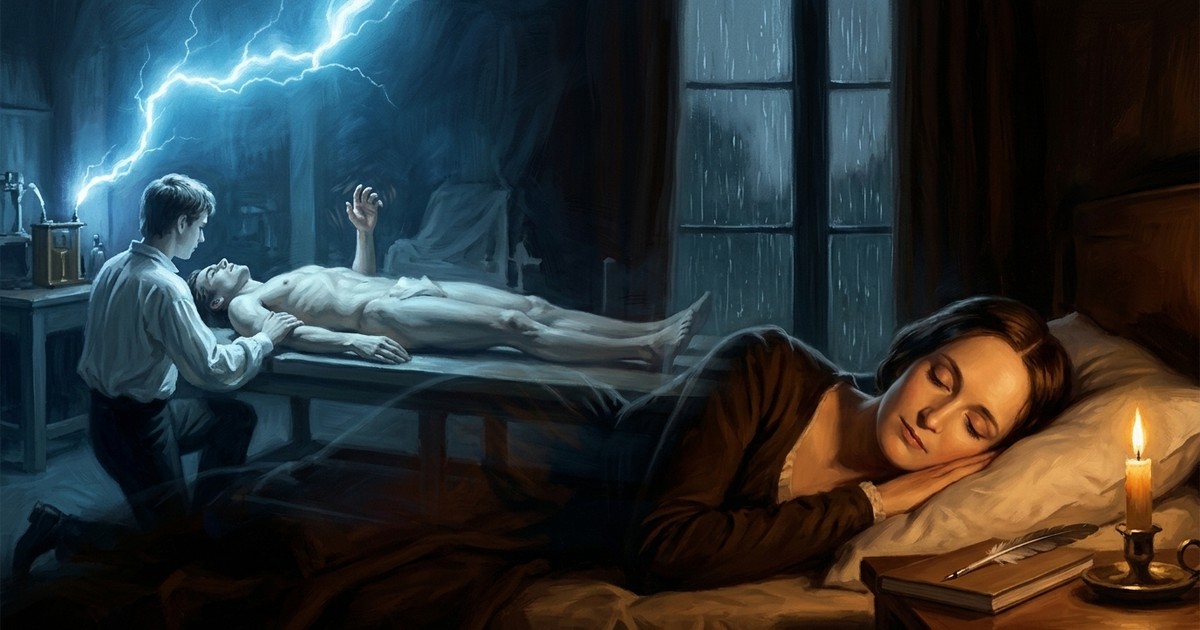
Mary Shelley Dreamed Frankenstein — Except She Wrote That She Was Not Asleep
Mary Shelley described that night herself: “I did not sleep, nor could I be said to think.” Not a dream but the threshold of sleep — and before it came days of deliberate work on an assigned problem, a late-night conversation about the principle of life, and years of a trained childhood habit of “waking dreams”. Here is the primary source, the 1831 introduction, together with where it is weak.