Alpha, beta, gamma: brain waves during a lucid dream
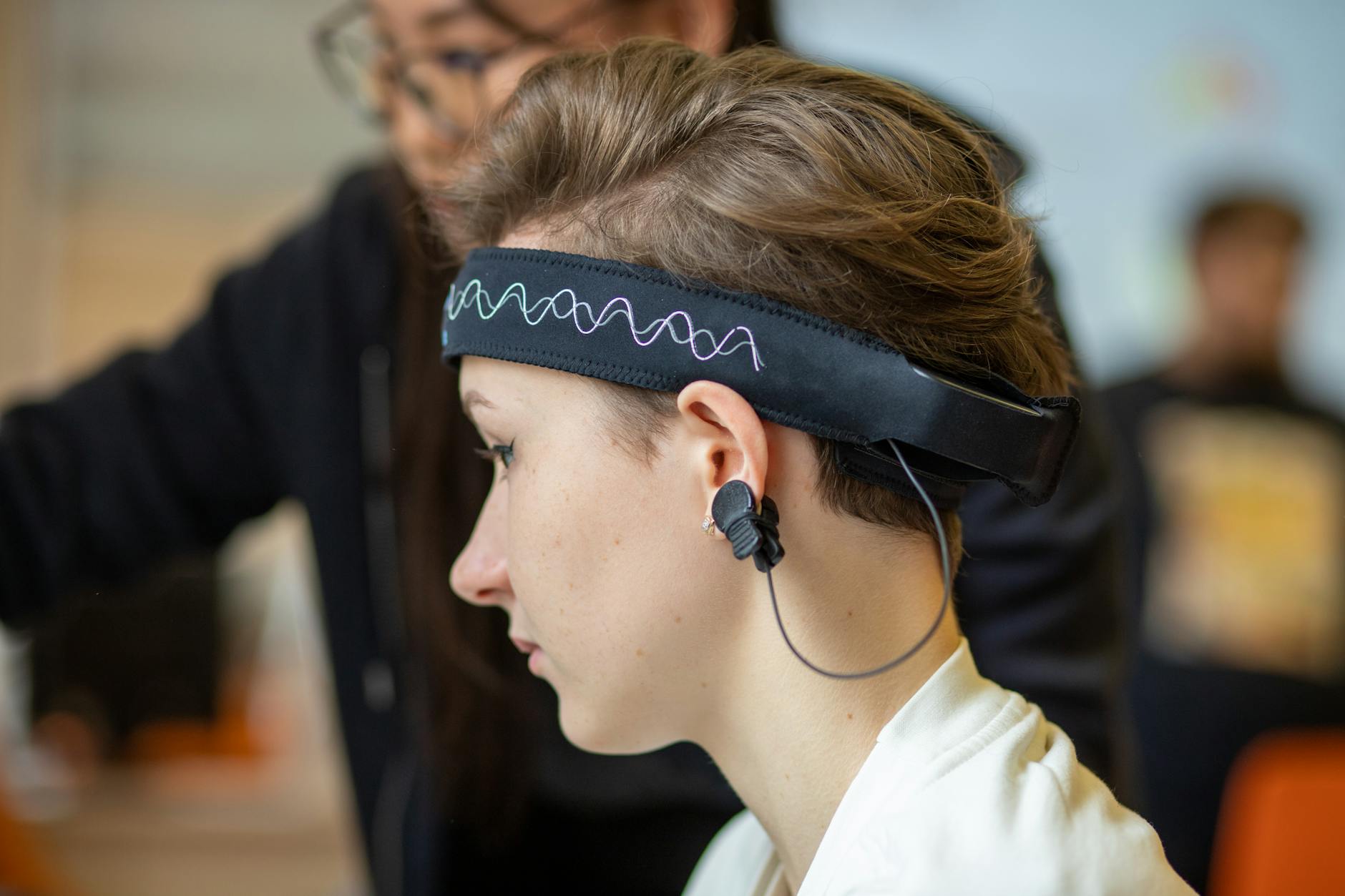
The brain constantly produces electrical oscillations that an EEG records as 'waves.' Each band is associated with a specific function. Waking is dominated by beta (13–30 Hz); relaxation by alpha (8–12 Hz); the moment of insight by gamma (30–100 Hz); deep sleep by delta (0.5–4 Hz).
What gamma waves are
Gamma is the fastest of the brain's main rhythms, roughly 30–100 Hz, with a notional 'peak' around 40 Hz. It is not a separate 'organ' but a mode of synchronised work across neural ensembles: when scattered patches of cortex start firing in a common beat, separate features such as colour, shape, meaning and memory bind into a single conscious image. That is why gamma is linked to the so-called binding problem, to focused attention, working memory and the subjective 'aha' moment. In a waking person a gamma burst accompanies insight, while in deep sleep it nearly vanishes. Its return to the prefrontal cortex in the middle of REM is exactly what turns an ordinary dream into a lucid one, which is what the rest of this article is about.
In ordinary REM the picture is mixed: the EEG resembles waking (low-amplitude fast waves), but the critical prefrontal zone is offline. That is why the dream feels real and its absurdity passes unnoticed. This is also what a merely vivid dream looks like, with no lucidity at all. At the moment of transition into lucidity the EEG pattern changes in three places simultaneously.
Beta waves drop in the temporo-parietal cortex. In waking this region handles spatial orientation and integration of body signals. The beta drop means the brain has successfully 'detached' itself from its own paralysed body and stopped processing its position. This is the neurophysiological correlate of full immersion in the dream scene.
Gamma waves erupt in the prefrontal cortex. A synchronised rhythm around 40 Hz is linked to higher integrative processes — self-awareness, working memory, attention switching. This is the moment the dreamer realises 'I am dreaming.' If you show a subject who has just sent a pre-arranged eye-signal their own EEG in real time, they will see the gamma flash a second before the signal.
Alpha connectivity rises in the posterior cortex. Alpha in waking is associated with relaxed concentration with closed eyes. In a lucid dream it holds the 'relaxed focus' — the inner gaze fixed on the dream scene. Without it the scene begins to dissolve and the dreamer wakes up.
The biochemistry behind all this is the balance of acetylcholine, serotonin and norepinephrine. High acetylcholine triggers REM. Serotonin and norepinephrine sustain critical thinking in waking; in REM they are suppressed. Lucidity emerges when the prefrontal cortex finds a way to 'reclaim agency' without suppressing REM neurochemistry — a rare and unstable equilibrium that practice can make more durable.
This is more than correlation. In 2014 Ursula Voss's group demonstrated causality: applying a weak alternating current to the frontal lobes at around 40 Hz (tACS) during REM sharply increased the proportion of lucid dreams compared with placebo. Stimulation at 25 Hz had a similar effect, other frequencies did not. So frontal gamma does not merely accompany lucidity — it triggers it, the most direct evidence available today.
Can you train your own gamma? Not directly by willpower — the rhythm is too fast and distributed. But indirectly, yes. Regular mindfulness and meditation raise baseline prefrontal gamma in waking, while a dream journal and reality testing teach that same region to switch on at the right moment. In effect, the whole induction toolkit trains the brain to reproduce that gamma flash on its own, without an electrode.
Practical takeaway. The EEG picture shows that lucidity is not 'willpower' but a specific event in neural networks that can be induced through intention (MILD), sleep architecture (WBTB), or external stimulus (auditory cue). All three methods work through the same point — a gamma flash in the prefrontal cortex.
The CIA Astral Projection Report: What the Gateway Document Actually Says and What Was on the Missing Page 25
The document is real and you can download it: 29 pages, dated 9 June 1983, signed by Lieutenant Colonel Wayne McDonnell. It is not a CIA report and not a manual for astral projection — it is an Army memo assessing a commercial audio course. Here is the primary source: what it says about leaving the body, why one page was missing for eighteen years, and what turned out to be on it.
Mary Shelley Dreamed Frankenstein — Except She Wrote That She Was Not Asleep
Mary Shelley described that night herself: “I did not sleep, nor could I be said to think.” Not a dream but the threshold of sleep — and before it came days of deliberate work on an assigned problem, a late-night conversation about the principle of life, and years of a trained childhood habit of “waking dreams”. Here is the primary source, the 1831 introduction, together with where it is weak.