Field notes
Mary Shelley Dreamed Frankenstein — Except She Wrote That She Was Not Asleep
Shelley called it a waking dream. Her 1831 introduction is a primary but late account of creativity, not evidence of a sleep stage or WILD training.
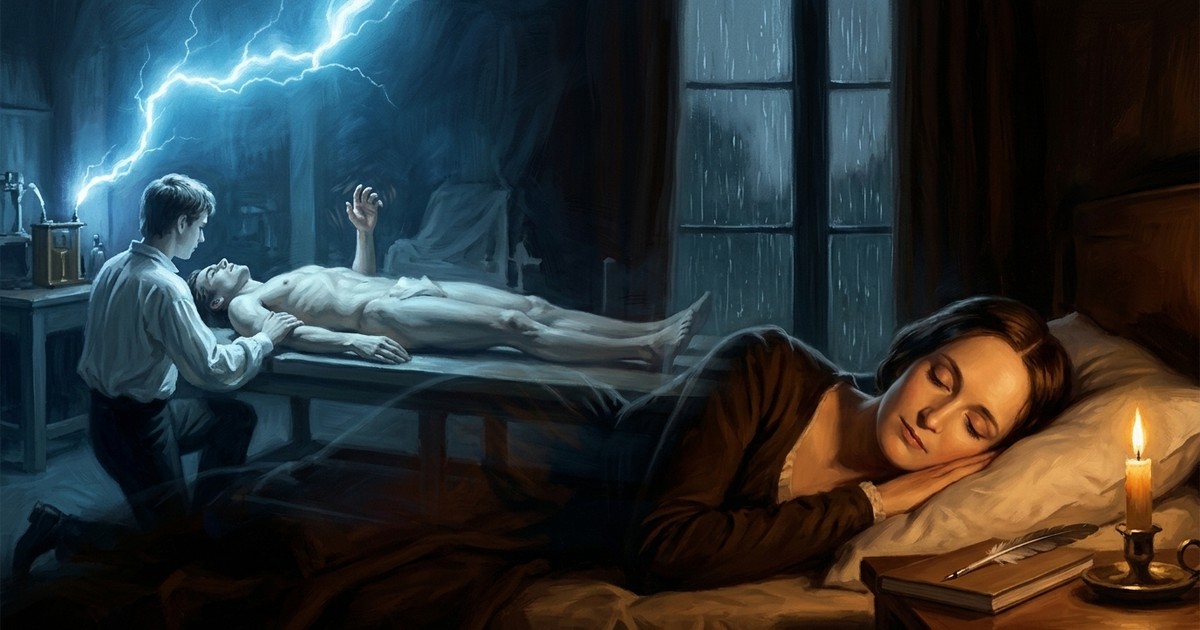
Everyone who has held a copy of Frankenstein knows the story: in the cold, rainy summer of 1816, at a villa on Lake Geneva, Byron proposed that each of them write a ghost story, and eighteen-year-old Mary dreamed a monster that night. In the morning she sat down and began the novel that started science fiction. I examine cases on this site where a dream genuinely gave someone something, and this is among the most quoted of them. It survives the check: we have Mary Shelley's own account. But what it says is not what gets retold, and the real story is more interesting than the myth.
She wrote that she was not asleep
The primary source is the introduction Mary Shelley wrote for the 1831 reissue. The key paragraph is worth reading verbatim: “When I placed my head on my pillow, I did not sleep, nor could I be said to think. My imagination, unbidden, possessed and guided me, gifting the successive images that arose in my mind with a vividness far beyond the usual bounds of reverie.” And then: “I saw — with shut eyes, but acute mental vision — I saw the pale student of unhallowed arts kneeling beside the thing he had put together.” She watches the thing stir “on the working of some powerful engine”, the artist rush away from his own handiwork in horror, and the eyes open.
She uses “waking dream” herself. Resemblance to descriptions of hypnagogia is an interpretation, not EEG evidence of a sleep stage or an established lucid dream.
The myth deletes everything that came before that night
What the retelling loses is the essential part: the vision did not arrive out of nowhere, and it did not arrive quickly. The problem was set from outside — “‘We will each write a ghost story,’ said Lord Byron; and his proposition was acceded to.” Then she describes the failure plainly: “I busied myself to think of a story… I thought and pondered — vainly. I felt that blank incapability of invention which is the greatest misery of authorship, when dull Nothing replies to our anxious invocations.”
And the most underrated detail of all: “‘Have you thought of a story?’ I was asked each morning, and each morning I was forced to reply with a mortifying negative.” Days, that is, of directed, unsuccessful, daily-audited work on one specific question. Exactly what the myth compresses into the single word “dreamed”.
The conversation that supplied the material
On the evening before the vision, the thing that became the novel was discussed in front of her. Her words: “Many and long were the conversations between Lord Byron and Shelley, to which I was a devout but nearly silent listener.” The subject was “the nature of the principle of life, and whether there was any probability of its ever being discovered and communicated”. They talked of Dr Darwin's experiments — a piece of vermicelli kept in a glass case until it began to move of itself; of a corpse perhaps being re-animated, since “galvanism had given token of such things”; of the component parts of a creature being manufactured, brought together, “and endued with vital warmth”.
That sequence is useful as an account of creative work. It establishes no causal mechanism: there is no control comparison or independent state recording.
Childhood reverie is not verified WILD training
This is what makes Mary Shelley's case a rare one, and it is almost never mentioned. In the same introduction she describes a habit going back to childhood: her favourite pastime was “the formation of castles in the air — the indulging in waking dreams — the following up trains of thought, which had for their subject the formation of a succession of imaginary incidents”. And separately: “my dreams were all my own; I accounted for them to nobody; they were my refuge when annoyed — my dearest pleasure when free.”
Childhood imagination cannot be equated with measured WILD preparation. The account does not show that this night resulted from a particular skill or that she could repeat it at will.
In the morning she did not write down a dream, she recognised material
What comes next in her text deserves separate attention, because it is the actual work. She did not rush to record the vision. First she tried to shake it off: “I could not so easily get rid of my hideous phantom; still it haunted me.” Only then: “Swift as light and as cheering was the idea that broke in upon me. ‘I have found it! What terrified me will terrify others; and I need only describe the spectre which had haunted my midnight pillow.’”
Then: “On the morrow I announced that I had thought of a story. I began that day with the words, It was on a dreary night of November, making only a transcript of the grim terrors of my waking dream.” The vision supplied a scene. What made it a novel was the decision that this scene answered the problem, plus the months of work that followed: “At first I thought but of a few pages — of a short tale; but Shelley urged me to develope the idea at greater length.”
Where this story is weak
Honesty requires naming this too. The 1831 introduction is a recollection fifteen years after that summer, and it was written to order: the publishers of the Standard Novels, having selected Frankenstein, “expressed a wish that I should furnish them with some account of the origin of the story”. The text is signed “London, October 15, 1831”. So what we have is an origin story composed at a publisher's request fifteen years later, a genre that invites dramatisation by its very nature.
It cannot be checked against her own diary: Mary Shelley's journal for May 1815 to July 1816 is lost, precisely the one that would cover that summer. The 1818 preface, written by Percy Shelley and signed “Marlow, September, 1817”, confirms the circumstances — “the season was cold and rainy”, German ghost stories by the fire, and “two other friends… and myself agreed to write each a story, founded on some supernatural occurrence” — but says nothing whatever about a dream. And Polidori's diary, the only near-contemporary record from inside the party, puts the start of the stories in mid-June; historians still dispute the exact dates of that evening.
What follows from this: the contest, the rainy summer and the conversations are corroborated by a source from 1817; the scene at the pillow is known only from her 1831 account. That is still an author's testimony about her own experience — a strong source, but a single and a late one.
How this differs from the Mendeleev case
Mendeleev’s story concerns a second-hand recollection; Shelley supplies a late first-person account. These are different source types. Absence of Mendeleev’s own report does not prove there was no dream; Shelley’s language does not establish physiology.
The threshold of sleep is a trainable state
WILD describes trying to retain awareness through falling asleep. Shelley’s introduction does not test that method or establish her episode as successful WILD.
Lucidity means knowing during a dream that you are dreaming, not mandatory control. Her text cannot establish whether she retained that understanding inside a formed dream.
What to do with this today
A cautious modern incubation exercise means one modest question before ordinary sleep, without demanding an answer. It is not a proven reproduction of the night of 1816.
A journal helps preserve observations on paper or a phone. Recording is not the only way to remember and is no prerequisite for having dreams; there is no exact memory-expiry window.
One more thing her story shows. Do not expect a finished answer to arrive. What came to her was an image, a pale student bent over his work, not a novel. The novel began with the decision that this was the answer to the problem, and with months of labour after it.
How to walk this path with guidance
Incubation, the threshold of sleep and lucidity inside a dream are three separate skills, and each has its own dead ends: images that will not stay, a threshold you either shoot straight past or meet as sleep paralysis, lucidity that arrives and falls apart in ten seconds. My method works on exactly this, from the journal and the first stable lucid dreams to conscious work with images inside the dream. If this resonates, apply: not every application is accepted, but a first conversation is always possible.
Read Shelley's 1831 introduction and the preface in the complete text. This is recollection, not a dream log from 1816. Hypnagogia is an interpretation, not an established diagnosis; childhood daydreaming does not prove WILD training or a repeatable technique.
Sources and context
Links lead to studies, first-person accounts or edition information. The text distinguishes an abstract, secondary quotation or book description from a full original. The author's observations are not clinical evidence or a guarantee; no independent clinical review is claimed.
Keep reading
7 min read
“Mendeleev Saw the Table in a Dream”: The Story Has a Single Source, and It Is Not Mendeleev
The familiar story comes through recollection. Distinguish Mendeleev’s scientific work, a second-hand account and the limits of verification, without claiming that no dream occurred.
7 min read
Dream incubation: seeding a question into sleep
Bring one modest topic to bedtime and record the morning, separating ideas from verified answers and research from promised results.