Field notes
“Mendeleev Saw the Table in a Dream”: The Story Has a Single Source, and It Is Not Mendeleev
The familiar story comes through recollection. Distinguish Mendeleev’s scientific work, a second-hand account and the limits of verification, without claiming that no dream occurred.
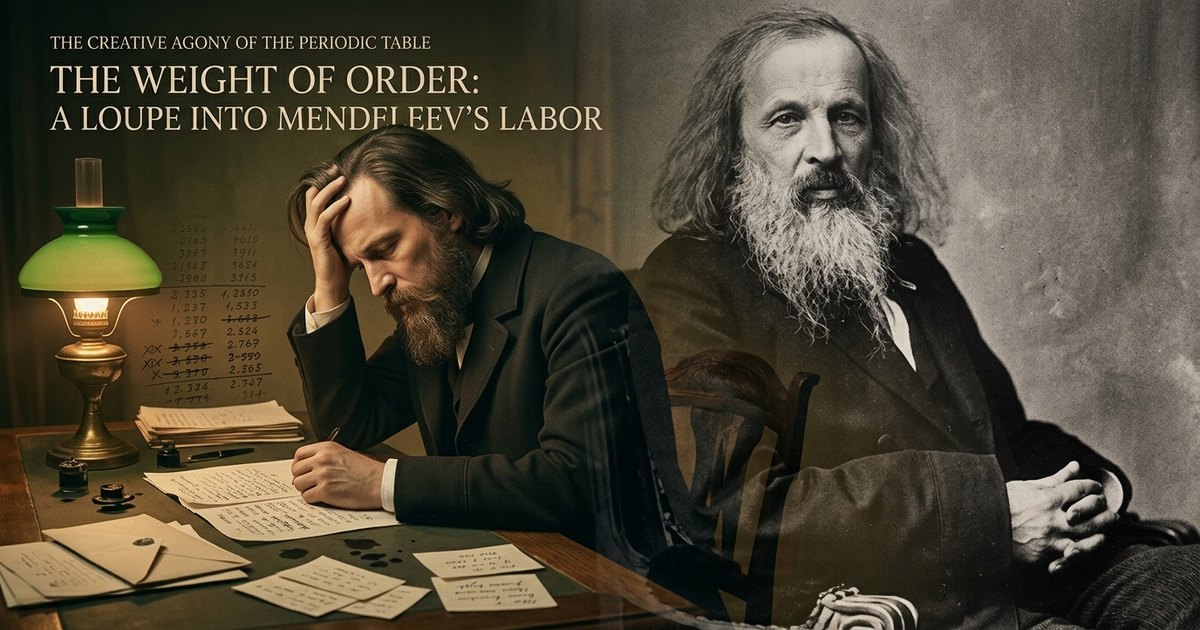
The famous story promises a finished table after one dream. Separate the chemistry, a later recollection and popular retellings. Sources accessible here do not establish whether a dream occurred, when, or what it contained.
A single source — and it is not Mendeleev
The anecdote is commonly traced to recollections by Mendeleev's colleague Alexander Inostrantsev: a retelling, not a dream report in the chemist's own hand. The original memoir passage is not supplied here; claiming to have checked every letter and diary would exceed the accessible evidence.
The table-in-a-dream sentence circulates as direct speech. Without the underlying record we cannot reconstruct its wording or who first rendered it in first person. Quotation marks do not turn it into Mendeleev's own document.
What Mendeleev himself said
The “twenty years” remark is also known through recollection, not Mendeleev’s own written record. Without the original passage I do not reproduce it as a verified direct quote. It proves no absence of a dream.
What is known about 17 February 1869
Here the firm part begins. The first version of the system — the manuscript titled An Attempt at a System of Elements Based on Their Atomic Weight and Chemical Affinity — is dated 17 February 1869 in the Julian calendar, that is 1 March in ours. The drafts from that day survive, and Bonifatiy Kedrov went through them sheet by sheet in his book The Day of One Great Discovery (1958): in effect a reconstruction of a single day from the archival papers.
What it shows is ordinary work done by hand. Mendeleev was due to leave that day for Tver province to inspect co-operative cheese dairies — he held such a commission — and he postponed the trip. The first sketches of that day were made on the back of a business letter about that very trip, from A. I. Khodnev, secretary of the Free Economic Society: the man used whatever was to hand. Then come comparisons of groups, rearrangements, crossings-out. And on 6 March the paper was presented to the Russian Chemical Society — not by its author: N. A. Menshutkin read it on his behalf.
“One correction in one place”
The most vulnerable detail of the legend is precisely the one that gives it its shine: a finished table, seen whole, and then a single fix. In reality Mendeleev kept reworking the system for two more years — moving elements, revising atomic-weight estimates — and in 1871 published a substantially revised version, the one his famous predictions of undiscovered elements grew out of. Two years of rework and “one correction” are not the same thing.
How this looks from the dream-research side
Historical literature discusses the mismatch between a finished-answer legend and sustained work on the system. Without direct access to a particular article we cannot attribute a verbatim verdict to it; a dream and prolonged work are not mutually exclusive.
Why this myth does harm
It looks like a harmless schoolroom anecdote. But look at its shape: a genius, three days, a dream, the finished answer. There is not a single step in it that anyone can repeat. It says that solutions come to the chosen and come free, and everyone else can wait for their night. I see the consequences constantly: someone tries for a week, nothing “comes”, and he concludes he is not one of those people. The truth is more useful: twenty years of work and one day when it fell into place. Work can be started today; a lottery cannot be started at all.
What really is there at the threshold of sleep
Whether Mendeleev obtained useful dream material is not established here. In general a dream may supply an image or association to check while awake; it is not a source of new external facts or a guaranteed solution. For contrast, Kekulé, unlike Mendeleev, left his own account of a half-sleep by the fire, and I go through his 1890 speech separately.
What of this can be trained
Incubation and a journal are limited exercises. Avoiding a phone is not required and an unrecorded dream is not automatically forgotten; neither an outcome nor a deadline is guaranteed.
Where to start
Begin by recording after ordinary waking. Look for recurring dream signs, without expecting them within two or three weeks. MILD guarantees no transfer of awareness; excitement is not a universal cause of dream ending.
How to walk this path with guidance
You need not wait for legendary inspiration to observe dreams. Recall and restrained rehearsal are skills, not a promise of discovery. For non-medical coaching, explore the method and apply.
Read Mendeleev's own The Principles of Chemistry, English edition of 1897. This is a primary scientific text, not the source of the dream anecdote. Draft details and memoir quotations above come through historical literature, not inspection of originals. Lack of a first-person report does not prove that no dream occurred.
Sources and context
Links lead to studies, first-person accounts or edition information. The text distinguishes an abstract, secondary quotation or book description from a full original. The author's observations are not clinical evidence or a guarantee; no independent clinical review is claimed.
Keep reading
16 min read
Did Kekulé Dream the Benzene Ring? What He Actually Said About the Snake, and Why He Was Accused of Making It Up
Kekulé told the snake story himself, in 1890. But in the original it is a half-sleep by the fire, the snake seizes its tail rather than biting it, and the famous “let us learn to dream” ends with a warning that usually gets cut. His speech, the 1984 fraud charge, where the monkeys came from, and what science knows about the edge of sleep.
7 min read
Dream incubation: seeding a question into sleep
Bring one modest topic to bedtime and record the morning, separating ideas from verified answers and research from promised results.