Field notes
Did Kekulé Dream the Benzene Ring? What He Actually Said About the Snake, and Why He Was Accused of Making It Up
Kekulé told the snake story himself, in 1890. But in the original it is a half-sleep by the fire, the snake seizes its tail rather than biting it, and the famous “let us learn to dream” ends with a warning that usually gets cut. His speech, the 1984 fraud charge, where the monkeys came from, and what science knows about the edge of sleep.
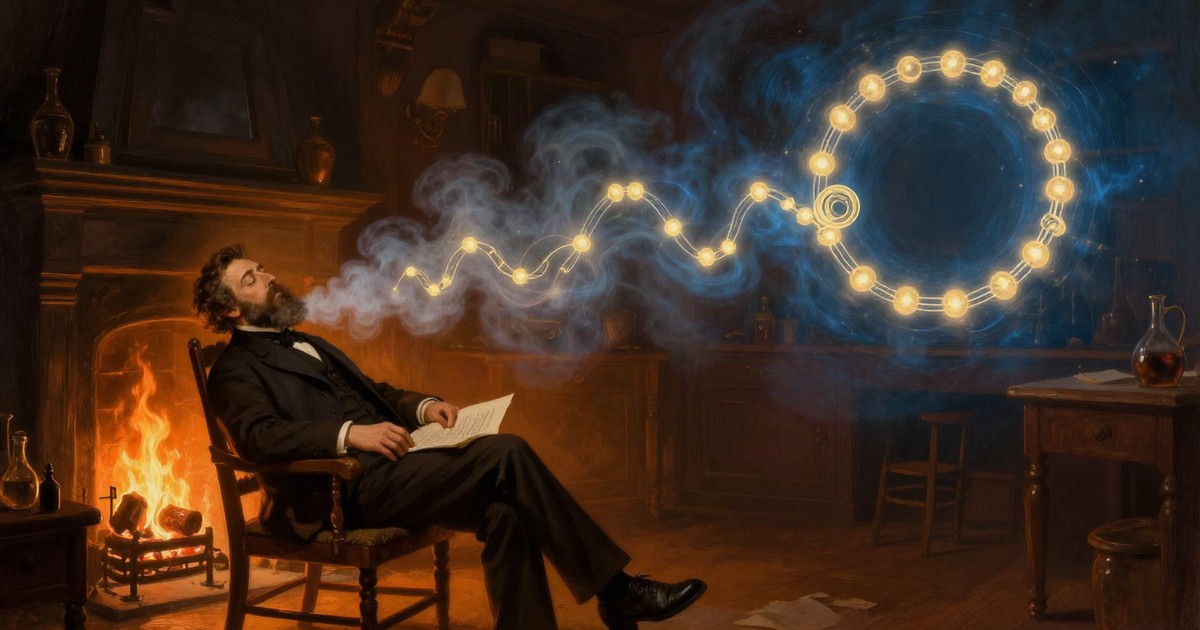
Every chemistry student hears the story: Kekulé dreamed of a snake biting its own tail, woke up, and realised that the benzene molecule is a closed ring. Unlike the Mendeleev legend, this one has a first-person source. Kekulé told it himself, in public, in 1890. But read his speech in the original and almost every detail of the textbook version shifts. It was not a dream in bed, the snake did not bite its tail, there were two reveries rather than one, and the famous call to “learn to dream” ends with a warning that nearly always gets cut. And in 1984 an American chemist publicly accused Kekulé of having made the whole thing up. Let’s go through the documents.
When and where he told it
On 11 March 1890 the German Chemical Society honoured Kekulé in the great hall of Berlin’s Town Hall: his benzene theory had turned twenty-five. The event was promptly nicknamed the Benzolfest, the benzene festival. The Society’s report, with the honoree’s full speech, is in its journal for 1890; Kekulé’s speech runs from page 1302 to 1311. Where no translator is named below, the translation from the German is mine.
It matters why he brought up dreams at all. Just before, Kekulé argues against the picture of a genius to whom everything comes at once: “It has been said that the benzene theory sprang, armed like Pallas Athena, from the head of a chemical Zeus. It may have looked that way, but even if it looked so, it was not so.” Then: “It is also said that genius thinks in leaps. Gentlemen, the waking mind does not think in leaps. That is not given to it.” Only after that does he offer his audience some “highly indiscreet disclosures” about how he arrived at certain of his ideas. What looked like a leap from the outside, he says, both times happened when he was not fully awake.
The first reverie: the top of a London omnibus
The first story is not about benzene at all. In the mid-1850s the young Kekulé was working in London as assistant to the chemist John Stenhouse. Here it is in the standard English translation, made by the chemist F. R. Japp for his Kekulé Memorial Lecture of 1898:
“During my stay in London I resided for a considerable time in Clapham Road in the neighbourhood of the Common. I frequently, however, spent my evenings with my friend Hugo Müller at Islington, at the opposite end of the giant town. We talked of many things, but oftenest of our beloved chemistry. One fine summer evening I was returning by the last omnibus, ‘outside,’ as usual, through the deserted streets of the metropolis, which are at other times so full of life. I fell into a reverie (Träumerei), and lo, the atoms were gambolling before my eyes! Whenever, hitherto, these diminutive beings had appeared to me, they had always been in motion; but up to that time I had never been able to discern the nature of their motion. Now, however, I saw how, frequently, two smaller atoms united to form a pair; how a larger one embraced two smaller ones; how still larger ones kept hold of three or even four of the smaller; whilst the whole kept whirling in a giddy dance. I saw how the larger ones formed a chain, dragging the smaller ones after them, but only at the ends of the chain.”
“The cry of the conductor: ‘Clapham Road,’ awakened me from my dreaming; but I spent a part of the night in putting on paper at least sketches of these dream forms. This was the origin of the Structurtheorie.” That is his structure theory of 1858: carbon is tetravalent, and carbon atoms can link to one another in chains. Remember this omnibus, because the monkeys will attach themselves to it later.
The second: a chair by the fire in Ghent
From 1858 Kekulé was a professor in Ghent, in Belgium, and the second story happened there. Japp left out the opening, so here it is from the German: “During my stay in Ghent, in Belgium, I lived in elegant bachelor rooms on the main street. My study, however, faced a narrow side alley and had no light during the day. For a chemist who spends the daylight hours in the laboratory, this was no disadvantage.”
Then Japp’s English: “I was sitting, writing at my text-book; but the work did not progress; my thoughts were elsewhere. I turned my chair to the fire and dozed. Again the atoms were gambolling before my eyes. This time the smaller groups kept modestly in the background. My mental eye, rendered more acute by repeated visions of the kind, could now distinguish larger structures, of manifold conformation: long rows, sometimes more closely fitted together; all twining and twisting in snake-like motion. But look! What was that? One of the snakes had seized hold of its own tail, and the form whirled mockingly before my eyes. As if by a flash of lightning I awoke; and this time also I spent the rest of the night in working out the consequences of the hypothesis.”
How the original differs from the textbook version
It was not a dream in bed. Kekulé is sitting on a chair by the fire, and the German word Japp rendered as “dozed” is Halbschlaf, half-sleep. In the Ghent passage the word for dream, Traum, does not occur at all: he speaks of half-sleep, visions and waking. Today the state would be called hypnagogic, the transition from wakefulness into sleep.
The snake does not bite its tail. The German verb is erfasste, “seized”. The biting was added by later retellers. What the retellings dropped is the word höhnisch: the form whirled “mockingly”.
It was not a one-off revelation. Kekulé speaks of “repeated visions of the kind”. The atoms had danced before his eyes before, and the omnibus scene was one of those times.
His account has neither the number six nor a year. “A snake of six carbon atoms” is popular embellishment. The year is a later addition too: a popular book of 1917 inserted “(1865)”, which is the year of publication. Historians place the scene around 1862, reasoning from the “bachelor rooms”, since Kekulé married that year. That is an inference, not a date from the source. Even Japp shifted a detail: the German has a fine summer day, not an evening, although the “last omnibus” does suggest a late hour.
And he did not “wake up with the answer”. He woke up with a hypothesis and spent the rest of the night working out what followed from it.
“Let us learn to dream, gentlemen”, in full
Right after the snake comes the most quoted sentence of the speech. In full it reads: “Let us learn to dream, gentlemen, then perhaps we shall find the truth: ‘And he who does not think, to him it is given, he has it without care’, but let us beware of publishing our dreams before they have been put to the proof by the waking understanding.”
The verse in the middle is the witch’s spell from the “Witch’s Kitchen” scene in Goethe’s Faust, and Faust himself immediately calls it nonsense. Japp’s 1898 translation replaced those lines with an ellipsis, and popular retellings usually lose the end of the sentence as well, the part about testing by the waking mind. We do not know in what tone Kekulé quoted the witch. But the end of the sentence is unambiguous: a dream may suggest, and the waking test decides.
What came before that night
The benzene idea did not come out of nowhere. As early as his 1858 paper Kekulé wrote that benzene and its derivatives require a “denser” arrangement of carbon atoms. He saw the problem seven years before the ring.
In the same 1890 speech he says so himself: “My views too grew out of those of my predecessors and lean on them. There can be no question of absolute novelty.” And the benzene theory, he says, “lay written in my papers for nearly a year” until a synthesis of aromatic hydrocarbons by Fittig and Tollens prompted him to publish.
The publication itself contained no dreams at all. On 27 January 1865 the chemist Adolphe Wurtz presented Kekulé’s paper “On the constitution of aromatic substances” at a meeting of the Chemical Society of Paris, with Louis Pasteur in the chair. In it Kekulé writes that he had conceived the theory “quite a long time ago”, while drafting the chapter on aromatic substances for his textbook, the same textbook he was struggling with by the fire. Neither that paper, nor the long German version of 1866, nor an 1872 paper in which he promised to add “some little-known moments” to the history of benzene, mentions a dream. The snake first appears in print in 1890, twenty-five years later.
One more detail from the speech is worth knowing before anyone imitates Kekulé. He recalls the advice of his teacher Justus von Liebig: “If you want to become a chemist, you will have to ruin your health; whoever does not ruin his health by study gets nowhere in chemistry nowadays.” And he admits: “I followed this advice faithfully. For many years four and even three hours of sleep were enough for me.” The man in the chair by the fire was not only absorbed in a problem; he had been short of sleep for years.
The charge: “Dreams don’t come with footnotes”
In 1984 the chemist John Wotiz of Southern Illinois University and his graduate student Susanna Rudofsky published “Kekulé’s Dreams: Fact or Fiction?” in Chemistry in Britain. The New York Times summarised their case in 1988. The snake story first appears only in 1890. Ring-like pictures of benzene supposedly existed earlier, from the Frenchman Auguste Laurent in 1854, the Scot Archibald Scott Couper and the Austrian Josef Loschmidt in 1861. And there was a motive: “By claiming to have made two major discoveries with the help of dreams, Dr. Wotiz contends, Kekule shrewdly avoided sharing credit with deserving foreign colleagues.”
In an oral-history interview in 2000 Wotiz put it in one line: “Dreams don’t come with footnotes and references!” One of his observations does hold up in the documents: Kekulé knew Loschmidt’s booklet. In a letter to his friend Emil Erlenmeyer dated 4 January 1862, he says Erlenmeyer’s own critique of a colleague’s chapter was “about on a par with Loschmidt’s confusion formulas”, Confusionsformeln in the original.
To be fair, Wotiz and Rudofsky themselves conceded that “nobody will ever really know whether the event in question took place or not.”
What the documents show
The dispute ran for almost a decade, with a centenary symposium in 1990, a 1993 book called The Kekulé Riddle and even lawsuits. Here is what is left of it when you read the texts themselves.
Loschmidt’s circle was not a ring. In his 1861 booklet he wrote plainly that the structure of the benzene nucleus could not yet be decided and that “we can hold our decision in suspenso”. For the six-carbon nucleus he adopted a symbol, a circle, and treated it “as though it were a six-sited element”. The historian of chemistry William B. Jensen concluded in 1989 that the circle stands not for a ring of six atoms but for “the spherical domain of a large, undifferentiated, hexavalent pseudoatom”.
Laurent and Couper fare similarly. Laurent called his 1854 drawing a “polyèdre complet”, a complete polyhedron, not a ring of linked atoms. Couper’s rings contained atoms of other elements and were not aromatic. Above all, as the historian Alan Rocke points out, nobody before Kekulé had even attempted to build an empirical argument for any specific structure of benzene. Kekulé was the first to propose a ring of six carbon atoms with alternating single and double bonds, and the first to argue for it from experimental evidence.
Nor did Kekulé hide Loschmidt. He named him in footnotes in both the 1865 paper and the German version of 1866, admittedly only to say that he preferred his own way of writing formulas.
Even Alfred Bader, the best-known champion of Loschmidt’s priority, wrote in 1998: “I suggested that Kekulé may have plagiarized Loschmidt. I no longer think so.” In the same breath he added that we can never know for certain whether Kekulé even had the dream.
Alan Rocke, a historian at Case Western Reserve University, answered Wotiz from the start. In a letter to The New York Times he wrote that Wotiz “has gained few converts among professional historians of science.” In a 2015 essay he explains why he is “strongly inclined to trust Kekulé’s sincerity”. By 1890 nobody, Couper and Loschmidt included, had contested Kekulé’s priority: “why would he want to invent false stories with the intention of asserting priority against rivals, when there were no rivals?” And in the same speech Kekulé insisted that dreaming alone is not enough. But Rocke is candid about the limits: a private mental event cannot be documented, and even a sincere man’s memory may not be accurate.
So here is where it stands. Kekulé’s dream is a late first-person account, and it cannot be verified. Most historians who have worked through the documents regard it as sincere. The claim that someone else drew the ring first is not supported by the documents.
Where the monkeys came from
Some retellings, especially in Russian, have a different version: Kekulé saw monkeys linking up into a ring. That one has a source too, but it is not Kekulé.
In September 1886, four years before the anniversary speech, a joke issue of the Society’s journal was printed for its beer evening: the “Berichte der durstigen Chemischen Gesellschaft”, the Reports of the Thirsty Chemical Society. Its mock session is chaired by one “Aujust Kuleke”. The issue contained a spoof paper, “On the constitution of benzene”, signed with the invented name F. W. Findig. In it six macaques form a ring by holding each other alternately with two hands and one, and in a second drawing their tails join in. There is no dream in it; it is a joke analogy.
The first-person version came later. A school textbook of organic chemistry by Bernhard Bavink (the story is in its 1924 edition) has Kekulé riding a London omnibus and seeing a cage of monkeys that grab each other and form a ring. Bavink himself added: “If it is not true, it is well invented!” In 1926 the German newspaper Der Tag reprinted it as a quotation from Kekulé, and in 1927 his son Stephan traced where it had come from. A near-literal translation of Bavink’s text still circulates in Russian popular science as “Kekulé’s own account”, except that it has five monkeys.
What science knows about half-sleep
Kekulé’s Halbschlaf is what researchers call the hypnagogic state: the transition into sleep, when images arise on their own. It is a normal experience, not a sign of illness. How common it seems depends on how you ask; surveys have put it anywhere from 6% to 85% of people.
What surfaces at the edge of sleep was shown neatly by Robert Stickgold’s experiment in 2000. People who had played Tetris during the day reported intrusive images of the game as they fell asleep. So did three patients with severe amnesia who could not remember playing it. The falling-asleep brain replays what a person has been busy with. For Kekulé, writing a textbook and thinking about molecular structure for years, dancing atoms are exactly that kind of material.
Sleep can also help with solutions, but not out of nothing. In an experiment by Ullrich Wagner and Jan Born (Nature, 2004), people worked on a number task with a hidden rule. After a night’s sleep 13 of 22 found the rule; after the same number of hours awake, 5 of 22. But sleep did not help those who had not first trained on the task.
A Paris group studied the half-asleep state itself in 2021. Participants worked on a similar number task and then rested for twenty minutes holding a light bottle. Of those who spent at least 15 seconds in the first stage of sleep, 20 of 24 found the rule; of those who stayed awake, 15 of 49; of those who slipped into deeper sleep, 2 of 14. But the groups were not assigned by the experimenters; they formed according to who happened to fall asleep. And two findings run straight against the textbook story. The content of the images at sleep onset did not predict who would find the solution. And the eureka moment came on average about 30 minutes after waking. The authors note that this “contrasts with the popular view (and Edison’s story) in which a solution to a problem seemingly arises as soon as we wake up.”
Even that result is not settled. In 2025 another group ran a preregistered study with 90 people and a different, perceptual task and found no benefit from the first stage of sleep: 14 of 22 found the hidden strategy, against 10 of 18 who stayed awake. Those who reached the deeper second stage did best, 24 of 28.
What follows for Kekulé? The science is compatible with his account: what surfaces at the edge of sleep really is what a person has been working on, and sleep does help people find hidden patterns. But no study tests his story, and there is no evidence that the solution lives in the image itself. If anything, the image is the occasion, and the solution is the work before and after.
How Kekulé differs from Mendeleev and Shelley
I have examined two other famous “discovered in a dream” stories on this site, and it helps to set them side by side. For Mendeleev there is no first-person account at all, only a colleague’s retelling. Mary Shelley described her vision herself, but fifteen years later and at a publisher’s request, and she insisted she had not been asleep. Kekulé also speaks for himself, twenty-five years later, before a hall full of colleagues, with details of place and circumstance. That is stronger than a retelling, but it is still a single late testimony. And in all three cases the documents show years of work before “that night”.
What you can take from it
Strip away the legend and Kekulé leaves a workable sequence, described in his own words. First, a problem you have lived with for years. Then the moment you stop pushing: the textbook “did not progress”, and he turned towards the fire. Then an image at the edge of sleep. And straight away, work: the rest of the night on consequences, almost a year before publication.
Parts of this can be trained. Dream incubation means a short question before sleep about a problem you have already worked on; without that prior work, as in Wagner’s experiment, sleep does not help. A dream journal, or just a notebook at hand, makes sure the image lands on paper the same night, the way Kekulé’s sketches did after the omnibus. And if you want to learn to linger at the edge of sleep itself, start with Dalí’s method and WILD.
One thing not to copy is his sleep. Three or four hours a night for years is not the secret of genius; it is chronic sleep deprivation. Images at sleep onset come to well-rested people too, and a full night’s sleep, as Wagner’s experiment showed, helps people find hidden patterns. Sleep hygiene matters more here than any technique.
And the last rule is his own: publish your dreams only after the waking understanding has put them to the proof.
How to walk this path with guidance
Incubation, the threshold of sleep and lucidity inside a dream are three separate skills, and each has its own dead ends: images that will not stay, a threshold you either shoot straight past or meet as sleep paralysis, lucidity that arrives and falls apart in ten seconds. My method works on exactly this, from the journal and the first stable lucid dreams to conscious work with images inside the dream. If this resonates, apply: not every application is accepted, but a first conversation is always possible.
Kekulé’s dream itself cannot be verified: it is his account from 1890, and none of the studies above tests it. Primary sources: the 1890 speech (pp. 1302–1311) and Japp’s 1898 English translation of its key passages. Details of the Erlenmeyer letter, Loschmidt’s booklet and the 1886 joke issue follow the biography of Kekulé published in 1929 by his former assistant and successor Richard Anschütz.
Sources and context
- the 1890 speech
- Japp’s 1898 English translation of its key passages
- “On the constitution of aromatic substances”
- The New York Times summarised their case in 1988
- an oral-history interview in 2000
- wrote in 1998
- a letter to The New York Times
- a 2015 essay
- Berichte der durstigen Chemischen Gesellschaft
- anywhere from 6% to 85% of people
- Robert Stickgold’s experiment in 2000
- an experiment by Ullrich Wagner and Jan Born
- in 2021
- preregistered study
Links lead to studies, first-person accounts or edition information. The text distinguishes an abstract, secondary quotation or book description from a full original. The author's observations are not clinical evidence or a guarantee; no independent clinical review is claimed.
Frequently asked questions
- Did Kekulé really dream the structure of benzene?
- That is what he said himself, in a speech in Berlin on 11 March 1890: half-asleep by the fire in Ghent, he saw chains of atoms twisting like snakes, and one of them seized its own tail. There is no earlier record, and his 1865 benzene paper mentions no dream. The story cannot be verified, but most historians who have studied the documents regard it as sincere.
- Was it a dream or a daydream?
- A half-sleep. Kekulé says he turned his chair to the fire and sank into Halbschlaf, half-sleep, then woke “as if by a flash of lightning”. He does not use the word for dream in that passage. Today the state would be called hypnagogic, the transition from wakefulness into sleep.
- Did Loschmidt draw the benzene ring before Kekulé?
- No. In his 1861 booklet Loschmidt used a circle as a symbol for the six-carbon nucleus and wrote plainly that he was leaving its structure undecided. In 1865 Kekulé was the first to propose a ring of six carbon atoms with alternating single and double bonds, and the first to argue for it from experimental evidence.
- Where does the story of Kekulé and the monkeys come from?
- From a joke. In 1886 a spoof issue of the German Chemical Society’s journal drew benzene as a ring of six monkeys holding hands. Later a school textbook by Bernhard Bavink turned it into a first-person story about a cage of monkeys that Kekulé supposedly saw from a London omnibus. Kekulé himself never told a monkey story.
Keep reading
8 min read
Mary Shelley Dreamed Frankenstein — Except She Wrote That She Was Not Asleep
Shelley called it a waking dream. Her 1831 introduction is a primary but late account of creativity, not evidence of a sleep stage or WILD training.
7 min read
“Mendeleev Saw the Table in a Dream”: The Story Has a Single Source, and It Is Not Mendeleev
The familiar story comes through recollection. Distinguish Mendeleev’s scientific work, a second-hand account and the limits of verification, without claiming that no dream occurred.