Field notes
Astral Projection and Out-of-Body Experiences: What They Are and Is Any of It Real
Astral projection, or an out-of-body experience, happens to a sizeable minority of people, mostly at the edge of sleep. What it is, what neuroscience has shown, whether anyone has seen something only visible from above, and whether it is dangerous.
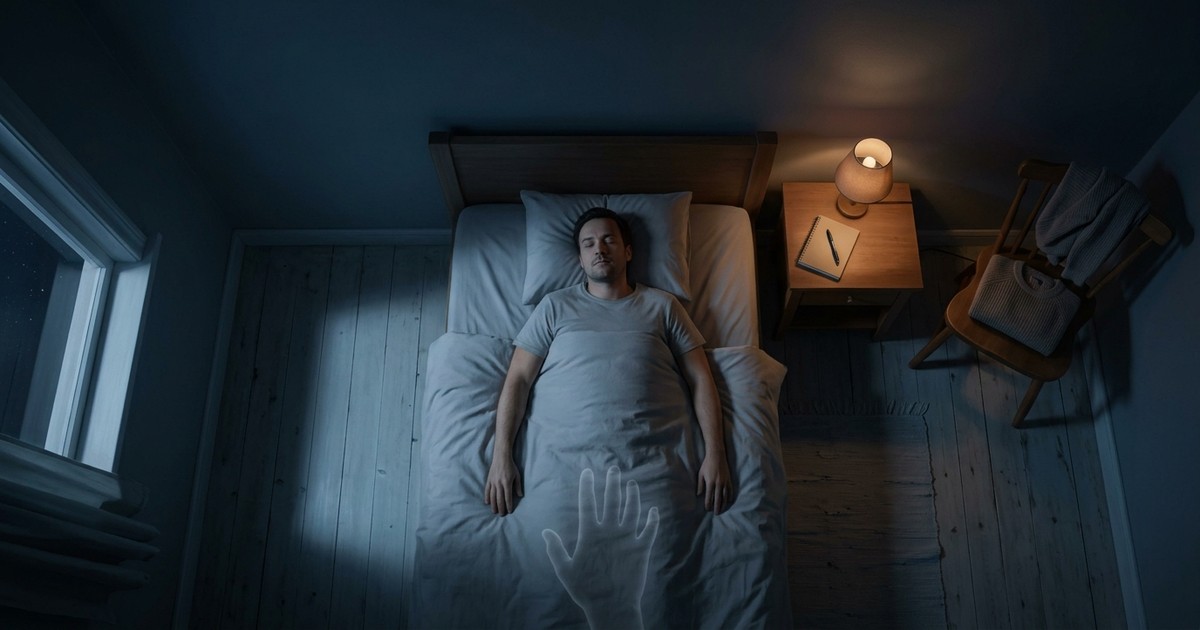
An out-of-body experience is the feeling that you are outside your own body: your sense of self and the point you are looking from sit somewhere else, usually above, and sometimes you see your body from the outside. It goes by many names: astral projection, astral travel, OBE. The short answer to the question most people arrive with: the experience is real, fairly common and well studied. There is no evidence that consciousness actually leaves the body. Here is what is known, and where it comes from.
What astral projection is
The neuroscientist Olaf Blanke, who has studied the phenomenon since the early 2000s, defines it this way: the person seems to be awake and sees their body and the world from a location outside the physical body. There are three parts to that: where “I” am, where I am looking from, and whether I see my own body. A close relative is autoscopy, seeing one’s own body, a double, in the space in front of you. All of this describes how the experience feels. It is not a claim about where consciousness actually went.
The word “astral” comes from esotericism. The term “astral projection” was coined and promoted by nineteenth-century Theosophists, and the idea of an “astral body” is much older. The classic occult manual of 1929, Sylvan Muldoon and Hereward Carrington’s The Projection of the Astral Body, defines it as “the Double, or the ethereal counterpart of the physical body”, tied to it by a “Silver Cord”. Scientists use a plainer name for the same experience: out-of-body experience.
How common it is
There is no single figure, and it is worth not inventing one. In the healthy control group of a 2018 study of out-of-body experiences in dizzy patients, 5% had had at least one, against 14% of the patients with dizziness. In a small sample of British students (2011), 17 out of 63, or 26%, said they had. Older review estimates quoted by current authors put it at 10 to 20% of the population.
There is data from Moscow too. Michael Raduga and colleagues at the Phase Research Center surveyed 974 people on the streets of Moscow: 88% had experienced at least one of four phenomena (lucid dreaming, an out-of-body experience, a false awakening or sleep paralysis) and 43% said they experienced them often. That is the rate for any of the four, not for out-of-body experiences alone. What it does show is that all four go together, and that they track sleep duration and how often people remember their dreams.
When it happens: the edge of sleep
Most often lying down and at rest. A survey collected in Scotland found out-of-body experiences associated with low physical activity and lying on the back, and those episodes were also the richest in features. The typical moment is falling asleep or waking up, especially together with sleep paralysis: the body is still paralysed, as it is in REM sleep, while the mind is awake.
The psychologists Cheyne and Girard showed that floating and leaving the body form their own cluster of experiences in sleep paralysis, which they describe as a breakdown in the normal binding of bodily-self sensations. In a Russian sample of 499 medical students, a third had had sleep paralysis, and their episodes were often accompanied by sensations of flying and leaving the body.
That is where the famous “vibrations” come from. Robert Monroe, author of Journeys Out of the Body (1971), described them as something “much like an electric shock running through the entire body without the pain involved”, together with being “utterly powerless to move”. Months of such episodes later, he found himself floating against the ceiling. There is more on him, and on the programme that grew out of his institute, in my reading of the Army’s Gateway report.
What neuroscience has shown
The strongest evidence that the brain can produce this experience by itself came from patients being prepared for epilepsy surgery. In 2002 Blanke’s group in Geneva electrically stimulated the right angular gyrus of a woman, and the out-of-body experience came back every time. Her words are still quoted today: “I see myself lying in bed, from above, but I only see my legs and lower trunk.” The same stimulation made her legs seem to grow shorter and her whole body seem to sink into the bed or fall from a height.
In 2004 the same group described six neurological patients with out-of-body experiences; in five, the damage or dysfunction sat in one area, the temporo-parietal junction. Along with the exit, the patients reported floating, flying, rising, spinning and distorted body parts. Belgian neurosurgeons saw the same in a patient with electrodes implanted to treat tinnitus. The authors’ conclusion is careful: out-of-body experiences may reflect a failure of the brain to bring together signals from the body (touch, position, balance) and vision.
Even in such studies it is rare. In a 2023 systematic review out-of-body experiences made up about 1% of all responses to electrical brain stimulation. Nobody has found an “out-of-body centre” in the brain; there is an area that turns up more often than others.
Healthy people can be “moved out” of their bodies without electrodes. In 2007 Science published two such experiments at once, one by Henrik Ehrsson and one by Blanke’s group. Participants had their visual perspective swapped and synchronised with touch, and they began to feel located outside their own body, or took a virtual body in front of them for their own and “drifted” towards it. What gets reproduced is not the whole experience but its key parts: where I am, and where I am looking from.
There is even a person who could do it at will. In a study at the University of Ottawa, a 24-year-old psychology graduate student said she had started at preschool, when she was bored during nap time, and was surprised to learn that not everyone could. In the scanner she “saw” herself rotating in the air above her body while staying aware of her real, unmoving body. Her brain activity looked like an unusual kind of kinesthetic imagery, and the authors called it an “extra-corporeal experience” to keep it apart from the classic out-of-body experience. It is one person: a lovely case, not a proof.
Is astral projection real? The tests
This is the question that brings most people to astral projection: is it consciousness that has really left, or a brain that paints a convincing picture? There is only one way to test it: hide something that can only be seen from above, and ask.
In 1968 the American psychologist Charles Tart put a five-digit number on a shelf above the bed of a subject in his sleep laboratory, and on the fourth night she named it. But there was no video monitoring, critics pointed out that she could simply have sat up, and according to the psychologist Susan Blackmore the EEG record showed exactly the kind of interference such a movement would produce. Resuscitation researchers later ran a far stricter version of the test.
In the AWARE study, more than a thousand shelves with images visible only from above were put up in five hospitals. Out of 2,060 cardiac arrests, 140 survivors were interviewed, 101 in depth. 9% had a near-death experience, 2% described “seeing” and “hearing” real events of their resuscitation, and one such account could be verified. But that patient was resuscitated where there was no shelf, so the image test never actually took place.
In the follow-up, AWARE-II, 25 hospitals showed an image on a screen and played a sound through headphones during resuscitation. Of 567 cardiac arrests, 53 people survived and 28 were interviewed. Nobody identified the image. One person identified the sound, but you can hear without leaving your body; it is not seeing from above. The same questions run through famous near-death stories; I have looked at Sharon Stone’s, for example.
So the honest state of play is this: the experience is genuine, and in a 2025 study of people who have had out-of-body experiences the researchers name its two most common qualities as peace and a sense of reality. But under controlled conditions, nobody has yet seen what could only be seen from outside.
Is astral projection dangerous?
There is no evidence that the experience itself does harm. The unpleasant part is fear: almost everyone with sleep paralysis feels it, and bliss is rare, though it turns up most often in floating episodes. The stories about a severed “silver cord” are folklore. Even the 1929 manual says plainly in its table of contents: “The projector cannot get lost.”
It is a reason to see a doctor when a similar state happens not at the edge of sleep but during the day, while active; when it comes with seizures, fainting, a severe headache or vertigo; or when a feeling that you or the world around you is unreal will not go away. The 2018 study notes that out-of-body experiences occur in epilepsy, migraine and depersonalisation, and in its dizzy patients they were predicted by depersonalisation, depression and anxiety.
The practice carries its own risk. Attempts to “get out” are usually built on interrupted sleep, and chronic sleep loss is a real cost, unlike the mythical “losing your body”. More in my piece on the risks of lucid dreaming.
Astral projection vs lucid dreaming
For me as a practitioner these are neighbouring doors. In a survey of 1,928 people (2017), lucid dreaming was linked to sleep paralysis, most of all to episodes of floating and leaving the body; the link is weak, though, and it is a correlation, not a cause. Stephen LaBerge put it this way: “a person experiences only one body, and this isn’t the physical body, but the body image.”
In practice, the conditions that lead to an out-of-body experience (the edge of sleep, the body asleep, attention awake) also lead to a lucid dream entered directly from waking. That is the WILD technique, often combined with waking up in the middle of the night. Neither state comes with a guaranteed method: a review of 35 studies found that no induction technique produces lucid dreams reliably, and no controlled study has shown a reliable way to induce out-of-body experiences. Promises of guaranteed astral projection in a few days are not backed by science.
Let’s be straight
I do not teach travelling outside the body. I teach staying conscious at the edge of sleep, recognising a dream from the inside and remembering what happened. Along the way, many people find the out-of-body feeling arrives by itself, and then it helps to know what is going on: a real, known and usually harmless experience that the brain produces where sleep meets waking.
The difference between “I had an out-of-body experience” and “my consciousness was outside my body” is the same one I drew in the story of the Army’s Gateway report: the first is an experience, the second is a claim about the world. There is plenty of data for the first. For the second, there is none yet.
Sources and context
- six neurological patients
- Sylvan Muldoon and Hereward Carrington’s The Projection of the Astral Body
- 2018 study of out-of-body experiences in dizzy patients
- sample of British students (2011)
- surveyed 974 people on the streets of Moscow
- survey collected in Scotland
- their own cluster of experiences in sleep paralysis
- a third had had sleep paralysis
- electrically stimulated the right angular gyrus
- still quoted today
- Belgian neurosurgeons
- 2023 systematic review
- Henrik Ehrsson
- Blanke’s group
- study at the University of Ottawa
- more than a thousand shelves
- 140 survivors were interviewed
- AWARE-II
- 2025 study of people who have had out-of-body experiences
- survey of 1,928 people (2017)
- review of 35 studies
Links lead to studies, first-person accounts or edition information. The text distinguishes an abstract, secondary quotation or book description from a full original. The author's observations are not clinical evidence or a guarantee; no independent clinical review is claimed.
Frequently asked questions
- What is astral projection?
- The experience of being outside your own body and seeing the world, and sometimes yourself, from another point, usually above. Scientists call it an out-of-body experience (OBE).
- Is astral projection real?
- The experience is real and well studied: it has been triggered by electrical brain stimulation and reproduced in virtual reality. There is no evidence that consciousness actually leaves the body; in the AWARE-II study, no cardiac-arrest survivor identified an image that could only be seen from above.
- Why does it happen when falling asleep?
- At the edge of sleep the body is already paralysed, as in REM sleep, while the mind is awake. The brain gets mismatched signals about where the body is and can place you outside it, especially during sleep paralysis and when lying on your back.
- Is astral projection dangerous?
- There is no evidence that the experience itself does harm; the unpleasant part is fear. See a doctor if similar episodes happen during the day, or come with seizures, fainting, severe vertigo or a lasting sense that things are unreal.
Keep reading
9 min read
CIA Gateway Process: What the 1983 Army Report Says About Astral Projection
The document is real and you can download it: 29 pages, dated 9 June 1983, signed by Lieutenant Colonel Wayne McDonnell. It is not a CIA report and not a manual for astral projection — it is an Army memo assessing a commercial audio course. Here is the primary source: what it says about leaving the body, why one page was missing for eighteen years, and what turned out to be on it.
6 min read
Sharon Stone Saw the Light: The Near-Death Experience That Rewrote Her Fear of Dying
Stone describes an experience during a serious medical crisis. Her account is not evidence that dream techniques can safely reproduce it.