Field notes
The Sleep Paralysis Demon: What It Is, Why Everyone Sees the Same One, and Can It Hurt You
The sleep paralysis demon is real as an experience, not as a being. Why people in every culture meet the same visitor on their chest, where the Hat Man comes from, whether it can hurt you, and what to do when it comes.
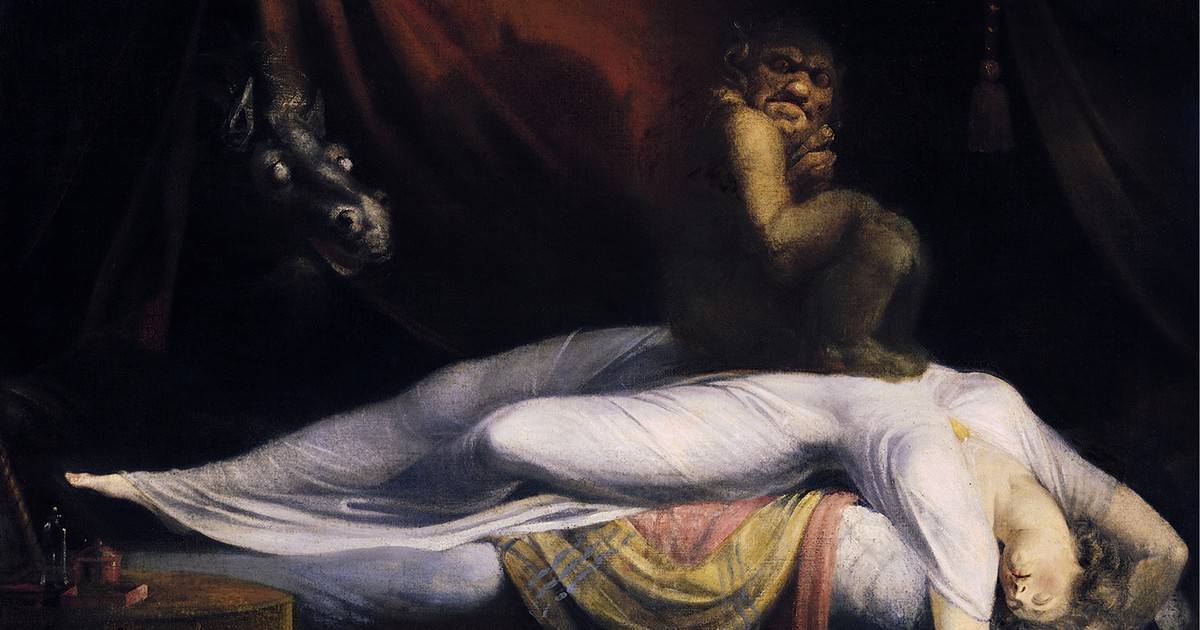
You wake up and cannot move. Someone is in the room. Something heavy sits on your chest, and you cannot scream. This is what people call the sleep paralysis demon, and the short answer to the question most of them arrive with is this: the demon is real as an experience and not as a being. It is sleep paralysis, a moment when the mind has woken up while the body is still in REM sleep, and the brain fills the dark with a visitor that looks much the same in every culture that has described it. Here is where that visitor comes from, why it looks the same everywhere, and why, for some people, the same moment turns out to be a door.
What the sleep paralysis demon is: “nightmare” originally meant exactly this
The English word gives the game away. According to the Online Etymology Dictionary, around 1300 nightmare meant “an evil female spirit afflicting men (or horses) in their sleep with a feeling of suffocation.” In the mid-sixteenth century the meaning moved from the spirit to the suffocating sensation it causes, and the sense “any bad dream” is recorded only by 1829. For five centuries a nightmare was not a bad dream. It was a visitor who sat on you while you could not move.
The mare in nightmare is not the horse, by the way: it is a separate Old English word for a goblin or incubus, from a different root. Russian hides the same visitor in its everyday word for a bad dream. Koshmar came through French cauchemar, which Vasmer’s etymological dictionary derives from Latin calcare, “to press,” and Old High German mara, “suffocation, nightmare.” A presser, in two languages at once.
The painting everyone uses, and the poem written about it
Nearly every article on the sleep paralysis demon is illustrated with the same picture: Henry Fuseli’s The Nightmare, painted in 1781 and shown at the Royal Academy in 1782. A sleeping woman is flung back across the bed, a squat demon sits on her chest, and a horse’s head pushes through the curtain. The horse is a visual pun, not the etymology. The Detroit Institute of Arts, which owns the original, notes that an engraving of it hung in Sigmund Freud’s apartment in Vienna, and in 1969 a psychiatrist writing in JAMA read it as a picture of sleep paralysis.
Eight years after the painting, the physician and poet Erasmus Darwin, Charles Darwin’s grandfather, wrote it into a poem, The Loves of the Plants (1789). His lines are a clinical description in rhyme: “In vain she wills to run, fly, swim, walk, creep; / The WILL presides not in the bower of SLEEP.” In a footnote he gives what may be the best one-sentence definition of the condition ever written: “When there arises in sleep a painful desire to exert the voluntary motions, it is called the Nightmare or Incubus.”
One small thing for anyone who quotes him. In the Project Gutenberg text the demon lands “grinning fits upon her breast.” That is a misread long s: the 1791 printing has ſits, and the line is “Alights, and grinning sits upon her breast.”
The painting also runs through the life of Mary Wollstonecraft. Her husband William Godwin wrote in his memoir of her (1798) that she “conceived a personal and ardent affection” for Fuseli, a married man. Her daughter, Mary Shelley, later wrote the scene in Frankenstein (1818) in which Elizabeth lies “thrown across the bed, her head hanging down, and her pale and distorted features half covered by her hair.” The literary historian Maryanne Ward argued in 2000 that the scene echoes Fuseli’s canvas. That is an interpretation, not something Shelley said. I wrote separately about the night Frankenstein began.
The same visitor in every culture
The earliest detailed case history I know of is Dutch. In 1664 the physician Isbrand van Diemerbroeck described a woman of fifty under the title “Of the Night-Mare.” In the 1694 English translation, “sometimes she believed the Devil lay upon her and held her down”; at other times a great dog or a thief seemed to lie on her breast, so that she could hardly speak or breathe, and she could not move. The fit came back “especially if she lye upon her Back.” A 2008 paper calls it the earliest detailed account of sleep paralysis with hallucinations. It is not the first description: Persian physicians wrote about the night-mare, kabus, in the tenth century, and in Rhazes the sleeper “senses a heavy thing upon him and finds himself unable to scream.”
Then come the names. In Newfoundland it is the Old Hag, and people say they were “hagged.” In Japan it is kanashibari, being bound so tight that you cannot move, and about 40% of 635 Japanese students had had it at least once. In Hong Kong it is 鬼壓床, “a ghost pressing on the bed”: 37% of 603 people. In Egypt it is the jinn, and 48% of a general-population sample blamed their episodes on one. In Turkey it is karabasan, literally “the black presser.” In Brazil it is the Pisadeira, a crone with long fingernails who “tramples on the chest of those who sleep on a full stomach with the belly up.” In Abruzzo it is the Pandafeche: a witch, a ghost or a terrifying cat. Among the Hmong it is dab tsog, the crushing spirit, and in Mexico people say “se me subió el muerto,” “the dead one climbed on top of me.”
Different names, different explanations, one structure: you wake, you cannot move, something is there, and it presses on your chest.
Newfoundland: the people who had never heard of the Hag
The obvious objection is that people see the demon because they have heard of it. The folklorist David Hufford tested exactly that. Working at Memorial University of Newfoundland, he questioned 93 students: 23% had had paralysis with the impression of being awake, and about 40% of the whole sample knew the Old Hag tradition. Most of those who had the experience had heard of it. But four had full Old Hag attacks with no knowledge of the tradition or of anyone else’s experience. Hufford called the finding “startling” and said it “cries out for confirmation.” Of those who said how they had been lying, 90% had been on their backs.
He then collected cases on the US mainland, where the tradition is practically unknown, and found the same pattern. His conclusion, set out in his 1982 book The Terror That Comes in the Night and restated in 2005, is that the pattern is not learned from culture; culture names what people were already experiencing. That is not a claim that the presence is real. It is a claim about where the story comes from: experience first, legend second. Keep in mind that it was 93 students, not a survey of Newfoundland.
Why everyone sees the same demon
The psychologist J. Allan Cheyne at the University of Waterloo collected thousands of accounts and found three groups of experiences that keep turning up together. The Intruder: a sensed presence, fear, sounds and figures. The Incubus: pressure on the chest, difficulty breathing, sometimes pain. And a third group he called Unusual Bodily Experiences: floating, flying, leaving the body, and occasionally bliss. The first two, he wrote, share “an implied alien ‘other’ consistent with occult narratives identified in numerous contemporary and historical cultures.”
In a later sample of 5,799 people, that structure was the same for people with few episodes and for veterans, which Cheyne read as a sign that the form of the hallucinations comes from processes in the brain, “independent of prior experience.” His explanation of why is a model, not a proven mechanism: the REM state switches on a threat-detection system first, so the alarm arrives before any source of it. You feel that someone is there. The brain then searches for the source and fills it in with whatever is nearest at hand: a hag, a jinn, a dead man, a shadow. One detail from his questionnaires: only a third of people could say whether the presence was male or female, and of those, 82% said male.
The Hat Man belongs here too. The name is recent. It was popularised by the paranormal author Heidi Hollis, who spoke about the “Hat Man” on the radio show Coast to Coast AM on 23 July 2008, and I found no peer-reviewed study of where the figure came from. But the hat itself is older than the internet. One of Hufford’s informants, long before any forum, described a figure where “it seemed like it had a hat or something”; the Turkish Kamos wears a leather börk; the Brazilian Pesadeira wears a red cap. I would not draw a line of descent from any of them to the modern Hat Man. The hat simply is not new.
Why it sits on your chest
Sleep paralysis happens when you wake up while the body is still in REM sleep, the stage in which the brain switches the muscles off. The weight on the chest has a plain explanation too. REM atonia spares the diaphragm, so breathing goes on, but the chest and neck muscles you would recruit for a deliberate deep breath stay switched off. A frightened person tries to take a deep breath, cannot, and feels the resistance as weight. Hence the demon on the chest, the dog on the breast, the hag, the dead man climbing on top. It feels like suffocation, but the diaphragm keeps working and breathing does not stop.
Position matters as well. In Cheyne’s survey of 6,730 people, lying on the back was 3 to 4 times more common during sleep paralysis than when the same people normally fell asleep. Diemerbroeck noticed it in 1664, Hufford in Newfoundland, and the Brazilian legend sends the Pisadeira to people who sleep “with the belly up.”
How common it is, and a number that gets misquoted
The best overview is a 2011 review of 35 studies covering 36,533 people: 7.6% of the general population, 28.3% of students and 31.9% of psychiatric patients had had at least one episode, and 34.6% of patients with panic disorder. You will often read that 20% of the general population has it. A 2017 opinion article says it in exactly those words: “we now know that 20% of the general population have SP episodes.” That misreads the review. About one in five is the figure pooled across all the samples, students and psychiatric patients included. For the general population, the number is 7.6%.
Can the sleep paralysis demon hurt you?
There is no evidence that the episode itself does harm. The damage, where there is any, is fear, and fear depends on what you believe. A study comparing Egypt and Denmark found sleep paralysis in 44% of Egyptians and 25% of Danes. Egyptians who had it reported 19.4 episodes in a lifetime on average against 6.0, longer immobility and great fear of dying. In Egypt, believing the episode had a supernatural cause went together with more fear and longer paralysis. That is an association, not proof that belief makes episodes longer, but it points one way: the scarier the story, the scarier the night.
The darkest story attached to the demon is a Hmong one. When young Hmong refugee men in the United States began dying suddenly in their sleep, the folklorist Shelley Adler proposed that terror during a dab tsog attack could act as a trigger in men with a hidden heart-rhythm vulnerability. The cause of those deaths is still not settled, and researchers who know the community note that dab tsog itself “is not rare or fatal, and is often experienced repeatedly.” So, can sleep paralysis kill you? Nothing shows that it can. The open question in that story is about hearts, not demons.
Is it a gift? The spiritual meaning of sleep paralysis
People often ask whether sleep paralysis has a spiritual meaning, whether it is a gift. My answer: it is neither a gift nor a curse. It is a state with two faces. Cheyne’s third group, floating and leaving the body, is the one most likely to be pleasant, and a 2023 survey of 329 people found out-of-body episodes more pleasant than the other hallucinations of sleep paralysis. But the pleasant face is rare: in Cheyne’s questionnaire data 96% of respondents reported fear and 83% had never felt bliss.
Hufford heard about the other face too. One questionnaire answer reads: “very cold, dead weight-great fear with no apparent reason, couldn’t move anything, only open eyes — had feeling of looking down at myself from separate place.” An informant he calls Pat said: “I began to enjoy the sensation of losing control. … It was a painstaking chore to sit there and try to move that finger. And once I moved it I could feel myself falling out.”
The door: Monroe and LaBerge
The man who made that second face famous is Robert Monroe. His book Journeys Out of the Body (1971) begins in the spring of 1958 with a state that anyone who has had sleep paralysis will recognise: “I was utterly powerless to move. It was as if I were being held in a vise.” His first reaction was everyone’s: “Shocked and frightened, I forced myself to move.” The state came back nine times in six weeks, always just after he lay down to rest or sleep. When he let one run until it faded, after about five minutes, he wrote: “With this result, I lost much of my fear of the condition.”
Months later, in one of these states, he found himself floating against the ceiling and looking down at two people in the bed, his wife and someone else: “I was the someone on the bed!” His later advice is the opposite of the instinct to fight: “The best method seems to be to do nothing when they occur,” and “Try to avoid panicky struggling to break the paralytic condition.” To leave, he suggests you “Think of getting lighter, of floating upward.” Monroe went on to found the institute whose Gateway tapes ended up in a 1983 US Army assessment. What science says about leaving the body I have covered separately.
Stephen LaBerge, the researcher who confirmed lucid dreaming in the sleep lab, wrote in 1990: “Sleep paralysis is not only nothing to be frightened of, it can be something to be sought after and cultivated. … Just step over and you’re in the world of lucid dreams.” There is some data behind the intuition. In a survey of 1,928 people, sleep paralysis and lucid dreaming went together, most of all for episodes of floating and leaving the body. But the link is small (r = 0.15), the sample was partly recruited on lucid-dreaming and sleep-paralysis forums, and no controlled study has shown that an episode can be turned into a lucid dream on purpose.
How to stop sleep paralysis when the demon comes
Monroe, LaBerge and the sleep researcher Baland Jalal, who studies sleep paralysis across cultures, agree on the first point: do not fight it. Jalal’s meditation-relaxation method comes down to four steps.
1. Name it. Tell yourself that this is sleep paralysis: common, temporary, a piece of REM sleep showing through. Keep your eyes closed.
2. Do not catastrophise. Fear feeds the episode; in Jalal’s words, catastrophising “will only make the episode worse and possibly prolong it.”
3. Turn your attention inward to something emotionally warm: a person you love, a memory, a prayer.
4. Relax your muscles and leave your breathing alone. Do not force a deep breath, and do not try to move.
Be clear about the evidence: the method rests on case reports and one pilot study in narcolepsy with six patients in the treatment group. It is sensible, not proven.
If episodes bother you, it is reasonable to sleep on your side and keep a regular schedule, since lying on your back and disrupted sleep are the situations most associated with them. See a doctor if episodes are frequent, frighten you enough that you avoid sleep, or come with strong daytime sleepiness or sudden muscle weakness. Those can point to narcolepsy, which needs a diagnosis, not a technique. More on the limits of sleep practices in my piece on the risks of lucid dreaming.
Let’s be straight
Can you go through the door on purpose? You can raise the odds, not flip a switch. In a Japanese sleep lab, researchers woke people at a set point in the night and let them fall back asleep. That schedule often sent them straight into REM sleep, and it produced sleep paralysis in 6 of 64 interruptions, about one in ten. Interrupted sleep followed by a fast return to REM is also the basis of wake-back-to-bed and of WILD, which is why practitioners meet paralysis on the way to a lucid dream. If you live with anxiety, panic attacks or PTSD, this is not a door I would open on purpose: sleep paralysis is notably more common in exactly those conditions.
I do not teach anyone to summon a demon, and I do not think anything sits on anyone’s chest. I teach staying conscious at the edge of sleep. On that path many people meet the visitor sooner or later, and it helps a great deal to know what it is: a real experience, as old as the word nightmare, made by a brain that woke up a moment before the body did. The demon is real as an experience. As a being, it is not.
Sources and context
- Online Etymology Dictionary
- Vasmer’s etymological dictionary
- Detroit Institute of Arts
- JAMA
- The Loves of the Plants
- 1791 printing
- memoir of her
- Frankenstein (1818)
- Maryanne Ward argued in 2000
- 1694 English translation
- 2008 paper
- “senses a heavy thing upon him and finds himself unable to scream.”
- 40% of 635 Japanese students
- 37% of 603 people
- 48% of a general-population sample
- literally “the black presser.”
- Pisadeira
- Pandafeche
- “se me subió el muerto,”
- restated in 2005
- three groups of experiences
- 5,799 people
- Coast to Coast AM on 23 July 2008
- spares the diaphragm
- 6,730 people
- 2011 review of 35 studies
- 2017 opinion article
- study comparing Egypt and Denmark
- proposed
- “is not rare or fatal, and is often experienced repeatedly.”
- 2023 survey of 329 people
- survey of 1,928 people
- meditation-relaxation method
- pilot study in narcolepsy
- 6 of 64 interruptions
- notably more common
Links lead to studies, first-person accounts or edition information. The text distinguishes an abstract, secondary quotation or book description from a full original. The author's observations are not clinical evidence or a guarantee; no independent clinical review is claimed.
Frequently asked questions
- Are sleep paralysis demons real?
- As an experience, yes: a sensed presence, weight on the chest and a dark figure are described in cultures all over the world. As beings, no. It is sleep paralysis: the mind has woken while the body is still in REM sleep, and the brain raises the alarm first and then fills in its source.
- Can sleep paralysis kill you?
- There is no evidence that the episode itself does harm. The diaphragm keeps working, so breathing continues even though it feels like suffocation. See a doctor if episodes are frequent, disrupt your sleep, or come with strong daytime sleepiness or sudden muscle weakness.
- Why do people see the Hat Man during sleep paralysis?
- A sensed presence is one of the most common sleep paralysis experiences, and the brain fills it in with a familiar shape. The name Hat Man spread after a 2008 radio show, but figures in hats or caps appear in older traditions too, such as the Turkish Kamos and the Brazilian Pesadeira.
- How do you get out of sleep paralysis?
- Do not fight it. Remind yourself that this is sleep paralysis and it will pass, keep your eyes closed, do not force a deep breath, and turn your attention to something warm and calm. These steps are sensible, but they have not yet been proven in clinical trials.
Keep reading
10 min read
Astral Projection and Out-of-Body Experiences: What They Are and Is Any of It Real
Astral projection, or an out-of-body experience, happens to a sizeable minority of people, mostly at the edge of sleep. What it is, what neuroscience has shown, whether anyone has seen something only visible from above, and whether it is dangerous.
9 min read
CIA Gateway Process: What the 1983 Army Report Says About Astral Projection
The document is real and you can download it: 29 pages, dated 9 June 1983, signed by Lieutenant Colonel Wayne McDonnell. It is not a CIA report and not a manual for astral projection — it is an Army memo assessing a commercial audio course. Here is the primary source: what it says about leaving the body, why one page was missing for eighteen years, and what turned out to be on it.